European farming is facing multiple stressors that are hard to manage all at once. In its new executive position paper, FarmTech Society (FTS) sets out how three proven technologies (Controlled Environment Agriculture, on-farm renewable energy, and water and soil protection) can be brought together in the EU's Climate Resilience Framework for 2027 to 2032.
The average EU farmer is 57 years old, and only about one in ten farm managers is under 40. Farms face drought, disease and changing consumer preferences. At the same time, three technologies are already proven and working. Making the most of them means training a new generation for green-skills careers that do not exist yet, under a single pathway called FarmTronix.
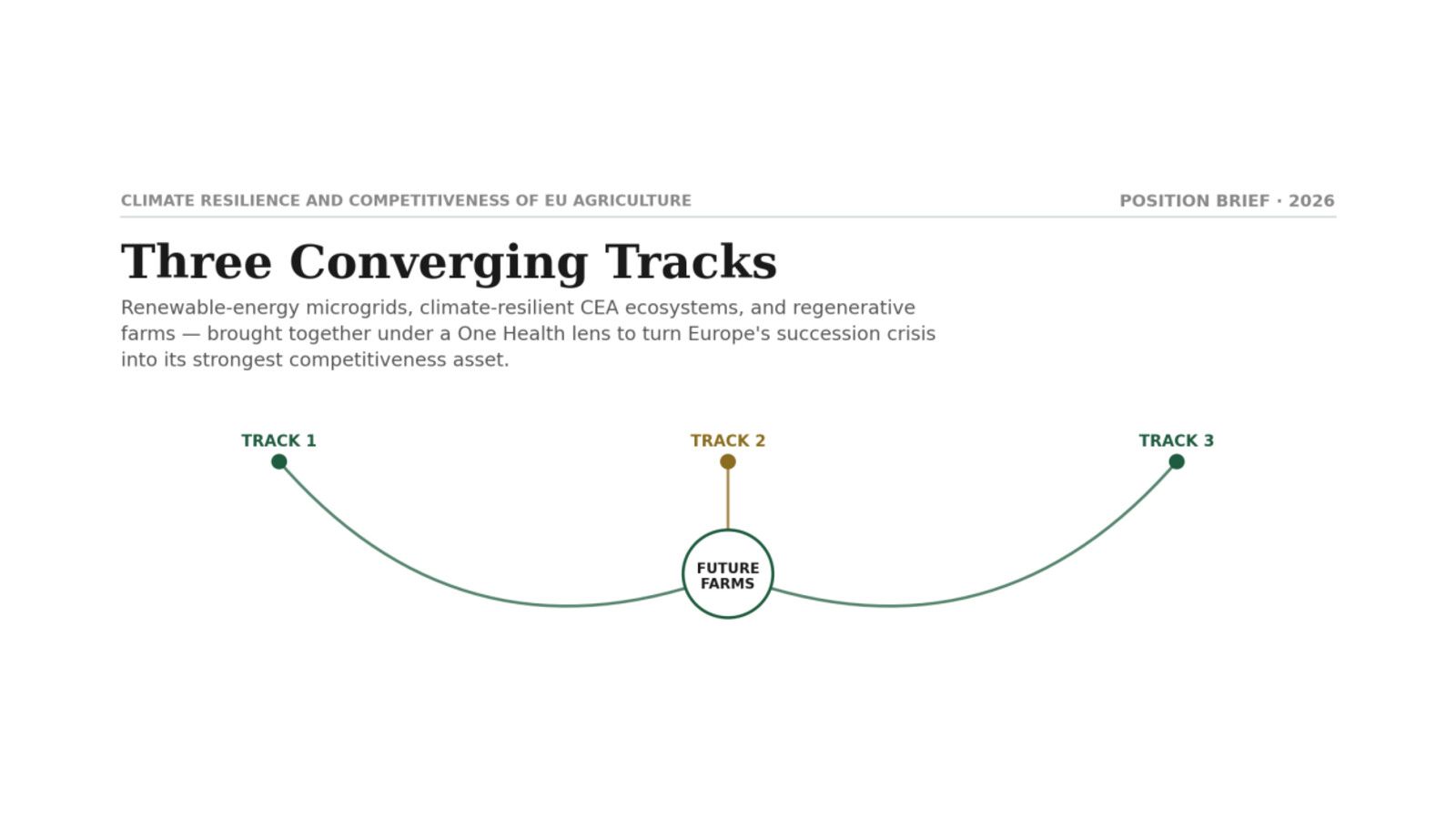
Three converging tracks
- Track 1 — Energy: on-farm biogas and process-heat microgrids. Digesters anchor an on-farm microgrid, so one investment yields food, feed, heat, power and gas together.
- Track 2 — Industry: CEA ecosystems on brownfield land. Intensive CEA relocates to brownfield sites, clustering to share infrastructure and close nutrient and water loops, without competing for farmland.
- Track 3 — Land: the regenerative transition of commodity farms, rebuilding soil and biodiversity once Tracks 1 and 2 absorb the volume they once carried.
What FTS is suggesting
- Standards: EU-wide standards so CEA system integration, on-farm renewable energy and conventional feed and food production can be compared fairly on water, energy and land use and on health outcomes.
- Skills: a comprehensive training path, the FarmTronix profile, covering jobs in on-farm energy, CEA operations and regenerative soil and water management. This is a succession solution as much as a vocational skills one.
- Brownfield incentives: incentives to build CEA and renewable-energy sites on unused industrial land, brownfields and empty buildings, reducing new construction on agricultural land.
- Pilot projects: dedicated Living Labs, supported through EU Taxonomy alignment, commercial financing instruments and regulatory flexibility, in regions that want to test all three approaches together before deploying at scale.
- Named priorities: CEA, on-farm energy, and water and soil health as named priorities in the new Climate Resilience Framework, each with a clear development route.
One Health
These three approaches work best together, not apart. Farming, energy and public health should be planned as one system, the approach international health agencies call One Health. CEA supports this directly: because growing conditions are actively managed, food functionality, such as the content of bioactive compounds, can be designed in at the point of primary production.
Download the executive position paper (PDF)
This is FTS's executive position paper, summarising the key asks and evidence behind our full technical position paper, which is available on request.